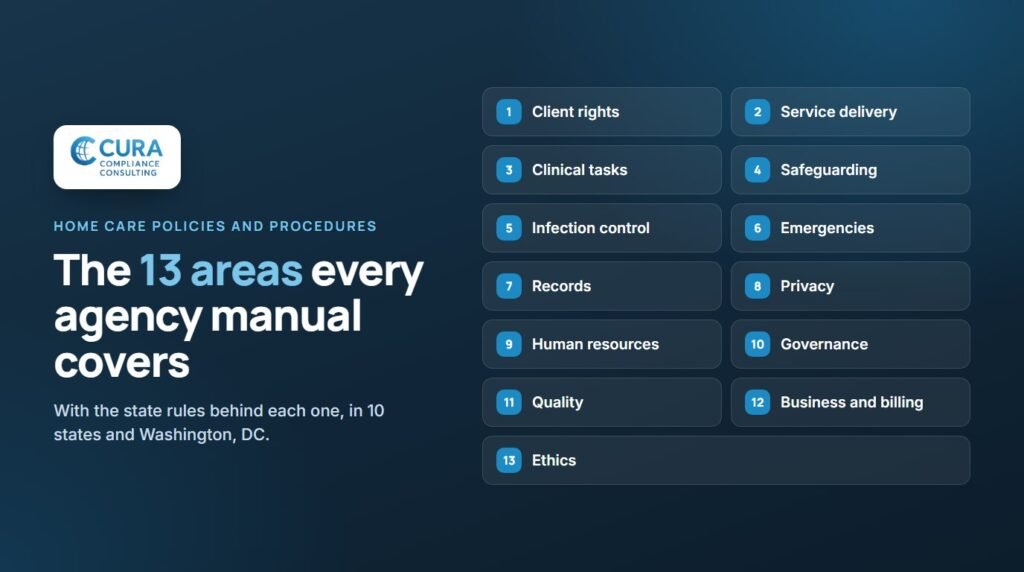
A home care policies and procedures manual is the written rulebook for how your agency runs and how your staff deliver care. In states that license home care, the rules call for written policies, and surveyors read them against those rules. The topics are much the same from state to state, but the details are not. Below are the 13 areas a home care manual covers, the kind of rule behind each one, and examples from the 10 states and Washington, DC we work in.
The 13 areas at a glance
| Area | What the policies cover |
|---|---|
| 1. Client rights and complaints | The rights clients are told about, consent, advance directives, how complaints are handled |
| 2. Service delivery | Intake, the service agreement, the care plan, scheduling, missed visits, supervision, discharge |
| 3. Clinical tasks and medication | What aides may and may not do, including help with medication |
| 4. Safeguarding | Spotting and reporting abuse, neglect and exploitation |
| 5. Infection control | Standard precautions and a bloodborne pathogens exposure control plan |
| 6. Emergency preparedness | Keeping services going through storms, outages and other emergencies |
| 7. Records | What goes in a client record, daily documentation, retention |
| 8. Privacy and security | Confidentiality, HIPAA, devices and breach notification |
| 9. Human resources | Hiring, background checks, health screening, training and competency |
| 10. Governance | Who runs the agency, the administrator, notices to the state, inspections |
| 11. Quality | Incident reporting and a quality improvement program |
| 12. Business and billing | Charges, insurance, Medicaid participation and electronic visit verification |
| 13. Ethics | Code of conduct, client money and property, and a compliance program |
What each area covers, with the rules behind it
1. Client rights and complaints
Every manual starts with the client. These policies set out the rights each client is told about at the start of service, who can make decisions for a client who can’t, how advance directives are recorded, and how a complaint is received, investigated and answered. North Carolina writes its list into law as a declaration of home care clients’ rights. Texas and Georgia set theirs in their licensing rules.
Examples: G.S. 131E-144.3 (North Carolina); 26 TAC §558.282 (Texas); Ga. Comp. R. & Regs. 111-8-65-.12 (Georgia).
2. Service delivery
This is the largest part of most manuals. It covers how a referral is accepted or declined, the written service agreement, the assessment and care plan, scheduling and what happens when a visit is missed, how aides are supervised, how changes in a client’s condition are reported, and how services end. In Florida, for example, services must be covered by an agreement with the client or their representative that sets out the services, the charges for privately paid services and how they will be paid. North Carolina sets out how in-home caregivers, including aides, are supervised and their competency checked.
Examples: s. 400.487, F.S. (Florida); 10A NCAC 13J .1110 (North Carolina).
3. Clinical tasks and medication
Your manual has to say exactly what your staff may do and what they may not. Help with medication is where states differ most: some allow reminders only, some allow unlicensed staff to assist with medication a client takes themselves, and some allow more with nurse oversight. Florida, for example, sets out what assistance with self-administered medication can include.
Example: s. 400.488, F.S. (Florida).
4. Safeguarding
These policies cover how staff recognize abuse, neglect and exploitation, who they report it to, how fast, and how a client is protected while an allegation against a staff member is looked into. The reporting duty usually comes from the state’s adult protective services and child abuse laws, so the hotline and the timing are different in every state. Texas also sets out how an agency reports suspected abuse of a client by its own staff.
Examples: s. 415.1034, F.S. (Florida); 26 TAC §558.249 (Texas).
5. Infection control
Standard precautions, hand hygiene, staff illness and what to do after an exposure. If your staff could come into contact with blood or other potentially infectious materials, federal OSHA rules also require a written exposure control plan.
Examples: 29 CFR 1910.1030 (OSHA); 26 TAC §558.285 (Texas).
6. Emergency preparedness
How you keep clients safe and services going through hurricanes, winter storms, power outages and other emergencies: which clients are most at risk, how you reach staff and clients, and when you call for help. Florida requires a comprehensive emergency management plan. Texas sets out emergency planning in its licensing rules.
Examples: s. 400.492, F.S. (Florida); 26 TAC §558.256 (Texas).
7. Records
What goes in each client’s record, how visits are documented, who can see records, and how long you keep them. Retention periods are set by each state, and Medicaid programs may set their own.
Example: 26 TAC §558.301 (Texas).
8. Privacy and security
Confidentiality of client information, use of phones and laptops, and what to do if information is lost or exposed. Agencies that bill Medicaid or insurance electronically are covered by HIPAA’s Privacy, Security and Breach Notification Rules. Many states add their own confidentiality and breach notice laws on top.
Example: 45 CFR Part 164 (HIPAA).
9. Human resources
Job descriptions, hiring, background and registry checks, health and tuberculosis screening, orientation, training, competency checks and personnel files. Background checks are a good example of how states differ: Florida uses Level 2 screening, Ohio sets its own criminal records check rules for home health and nonmedical home health agencies, and Pennsylvania has its own rules for direct care workers’ criminal history checks and competency.
Examples: s. 408.809, F.S. (Florida); ORC 3740.11 (Ohio); 28 Pa. Code §§611.52 and 611.55 (Pennsylvania).
10. Governance
Who owns and runs the agency, the administrator and who stands in for them, how policies are adopted, what you must tell the state and when (a new administrator, a move, a change of ownership, closing), and how you respond to inspections and plans of correction.
Example: 10A NCAC 13J .1001 (North Carolina).
11. Quality
How incidents and accidents are recorded and reviewed, and how you measure and improve your service over time. Texas requires a quality assessment and performance improvement program. North Carolina requires an annual program evaluation.
Examples: 26 TAC §558.287 (Texas); 10A NCAC 13J .1004 (North Carolina).
12. Business and billing
Charges and how they are explained to clients, billing and refunds, insurance, and the rules for Medicaid programs. Federal law requires states to use electronic visit verification for Medicaid personal care and home health services, so if you serve Medicaid clients, expect to use your state’s EVV system.
Example: 42 U.S.C. 1396b(l) (electronic visit verification).
13. Ethics
Professional boundaries, gifts, client money and property, conflicts of interest and a compliance program. Agencies that bill Medicaid or Medicare also check staff against the federal exclusion list, because those programs won’t pay for services from an excluded person. Texas also bans soliciting clients in certain ways.
Examples: HHS OIG exclusions; 26 TAC §558.255 (Texas).
Why one national template isn’t enough
The 13 headings are the easy part. What fills them is set state by state: how often aides are supervised, which background checks you run, how many training hours staff need, what aides may do with medication, how long you keep records, and what you must report and to whom. A manual written for one state can be wrong in the next one. A few examples from the states we cover:
- Some states don’t license non-medical home care at all. Michigan and Missouri are two. Agencies there still follow Medicaid program standards and federal rules, so they still need written policies.
- California home care organizations must make sure their aides are cleared on the state’s Home Care Aide Registry before they work with clients (H&S Code §1796.43).
- Florida requires a comprehensive emergency management plan, and its rules on assistance with medication are specific.
- North Carolina puts home care clients’ rights into statute.
Writing it is half the job
A manual on a shelf doesn’t help if your team hasn’t read it. Surveyors and reviewers commonly ask staff about policies, and many agencies keep a signed acknowledgment for every staff member and every policy. See our guide to proving your team has read every policy.
Rules change too. Review your manual when a rule changes, when you add a service, and at least once a year, and have your team sign again for anything that changed.
Policies and procedures for your state
See what a manual covers in your state, with the rules each policy follows:
- California
- Florida
- Georgia
- Louisiana
- Michigan
- Missouri
- North Carolina
- Ohio
- Pennsylvania
- Texas
- Washington, DC
Our Policy Portal has a complete manual for home care, home health and hospice agencies in each of these states. Every policy names the rule it follows, and your agency’s details fill in throughout.
Questions owners ask
Does a home care agency need a policies and procedures manual?
In states that license home care, yes: the licensing rules call for written policies, and they are reviewed during licensing and surveys. In states without a license, Medicaid programs and federal rules still expect written policies on topics like abuse reporting, privacy and infection control.
Can I use a manual written for another state?
Only as a starting point. The headings carry over, but supervision, background checks, training, medication help and reporting rules differ by state, and a policy that follows another state’s rule may not follow yours.
Is a home health or hospice manual different?
Yes. Home health agencies and hospices that bill Medicare also follow the federal Conditions of Participation, so their manuals cover clinical areas a non-medical home care manual doesn’t, such as physician or practitioner orders, skilled care planning and, for hospice, the interdisciplinary group.
How often should policies be reviewed?
Whenever a rule changes or you add a service, and at least once a year as good practice. Keep a record of what changed and when, and of who signed for the new version.
This is general information, not legal advice. The examples are the rules in force as of November 2026. Rules change, so check the source links and your state’s current rules.
Ready-made policy manuals from our Policy Portal
Our Policy Portal, Cura Core, has ready-made policy and procedure manuals for home care, home health and hospice agencies in 11 states. Each button opens those manuals on curacore.app, where you pick your state and can read three policies from any manual free. Every policy cites the rules behind it, and staff sign-off is built in.
Home Care Policy and Procedure Manuals
For: non-medical home care and personal care agencies
Open on curacore.appHome Health Policy and Procedure Manuals
For: skilled home health agencies
Open on curacore.appHospice Policy and Procedure Manuals
For: hospice agencies
Open on curacore.app